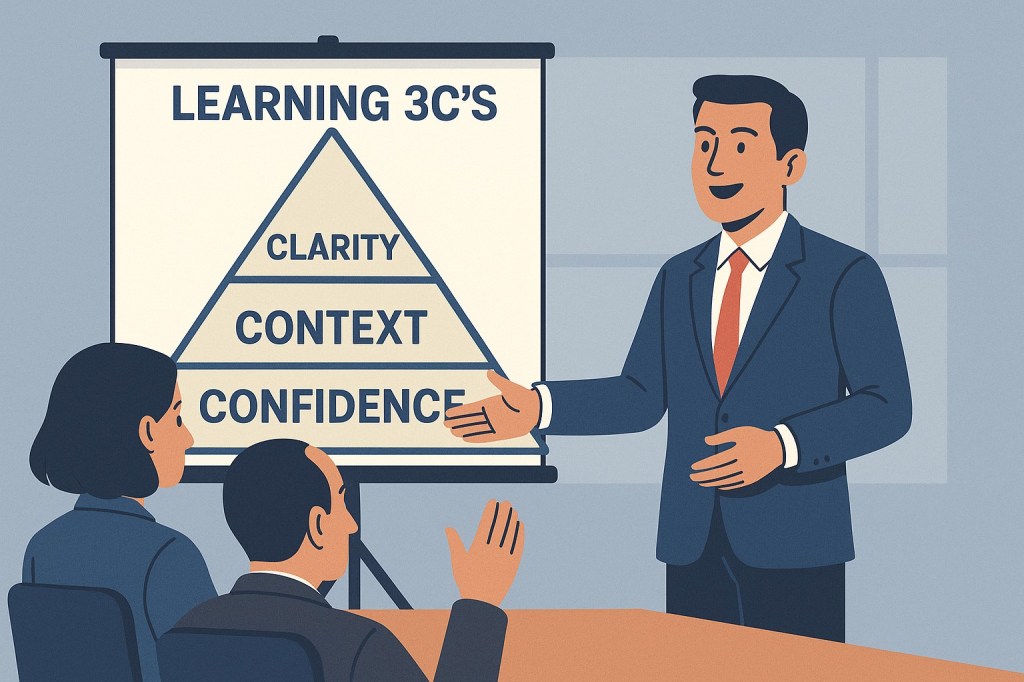
We’ve all been there. Sitting in a meeting, someone is explaining their big idea… and halfway through, you’re lost. Too many details, no clear point. You’re secretly wondering what’s for lunch or sometimes spending a lot of time collecting information and over-engineering the solution.
That’s where the 3C’s come in. A simple way to keep your ideas sharp, your message sticky, and your presence strong.
The 3C’s are:
- Clarity
- Context
- Confidence
Recently, I saw a challenge from ‘Flow Republic’ on mastering the 3C’s, then I realized that even though people know the framework but there are high chances they skip this when pressure is on.
Clarity: Say it so People Get It
Clarity is about making the complex feels simple.
- If you can’t explain your idea in one clean sentence, you don’t fully understand it yet.
- Ditch the jargon. Use stories, visuals, or even napkin sketches if needed.
- Remember: less “what the tech does,” more “what problem it solves.
Clarity is a kindness – it respects other people’s time and brainpower.
Context: Show Why It Matters
Even the sharpest idea falls flat without context. People need to know why it matters to them.
- Who’s the audience? A developer cares about API limits; an exec cares about ROI.
- What’s the bigger picture? Does your solution save money, reduce risk, or open new opportunities?
- Don’t over-engineer for fun. Anchor it to the real-world needs.
Context is connection – it makes people lean in because they see themselves in your story.
Confidence: Own Your Voice
Now comes the delivery. Confidence doesn’t mean being the loudest in the room—it means speaking like you believe your own words.
- Share trade-offs openly—it builds trust.
- If you don’t know, say so. That’s more powerful than pretending.
- Use body language and tone that match your conviction.
Confidence is contagious—when you’re steady, others trust the ground you’re standing on.
A Real-Life Example
I once saw a colleague present a new integration idea. Instead of diving into 10+ slides of technical detail, he started with this:
We can cut sync failures by 80% if we switch to event-driven design. It’ll scale with your future roadmap without adding new license costs.
Boom. In one line, he nailed clarity.
He followed up with context, explaining why it aligned with the client’s priorities.
And he delivered it with confidence – straightforward, calm, no buzzword soup.
The client’s reaction? “That makes sense. Let’s do it.”
Why This Matters
At the end of the day, the 3C’s aren’t about frameworks or fancy methods. They’re about being human. People want to understand you, see why it matters, and feel reassured by how you show up.
So before your next meeting, ask yourself:
👉 Am I clear?
👉 Am I in context?
👉 Am I confident?
Get those right, and you won’t just be heard—you’ll be remembered.
Quick Self-Check: Practice the 3C’s
Next time you’re about to explain an idea—whether to your boss, your client, or even your kids – pause and run through these 3 quick prompts:
- Clarity → Can I explain this in one simple sentence, without jargon?
(If not, try again until you can.) - Context → Why should this person care about what I’m saying?
(Tailor your answer to their priorities, not yours.) - Confidence → If I were listening to me, would I trust this delivery?
(Check your tone, pacing, and body language.)
Do this a few times, and you’ll notice how quickly your communication sharpens. The 3C’s aren’t theory – they’re a muscle you can train.
Do you agree with 3C’s, or do you think something’s missing from this model? What else do you rely on?
 CloudShetra
Leave a comment